

Recently, I was talking to a friend who reads my blog. She has been having a hard time convincing her husband that she should take Social Security early at 62. That conversation left me more convinced than ever that early claiming is the right call.
Since that conversation, I decided to do more research since my original post, Why I Took Social Security Early. This post pulls that research together. It also covers something new: how the Social Security Trust Fund is already running a deficit.
The trust fund isn’t what you think it is
You’ve probably seen a headline like “Trust Fund Set to Run Dry by 2033.” It sounds like a savings account with a countdown clock.
It isn’t.
What “no trust fund” actually means
Brett Arends explained this well. He’s a longtime columnist for The Wall Street Journal and MarketWatch. In a recent interview on Morningstar’s The Long View podcast, he said there’s no Social Security Trust Fund in any meaningful sense. I was shocked. What did he mean?
Here’s the reality. Social Security already pays out more in benefits each year than it collects in payroll taxes. That’s not a future problem — it’s happening now. The “trust fund” is really an accounting ledger. Think of it like an IOU between two branches of the same family. For decades, Social Security collected more in taxes than it paid out, and it lent that extra money to the rest of the federal government. The government spent it on other things and wrote an IOU in return. Now the situation has flipped — Social Security needs to cash in those IOUs to help cover today’s benefits. To do that, the Treasury has to come up with real money, either by borrowing it or pulling it from other tax revenue.
Independent research backs this up
The nonpartisan Brookings Institution describes this in almost identical terms. The trust fund isn’t a cash account you can tap. It’s an internal bookkeeping system that gives Social Security the legal right to draw down what the government already spent. (Yes, Social Security can run budget deficits — Brookings)
The Bipartisan Policy Center shows just how large this is in dollar terms. Social Security’s retirement program alone cost over $1.4 trillion in 2025. That’s close to a fifth of the entire federal budget. (Yes, the Social Security Deficit Adds to the Federal Deficit — Bipartisan Policy Center)
The government’s own numbers confirm it. The latest Trustees Report puts Social Security’s actuarial deficit at 4.42% of taxable payroll. In plain terms: the money coming in doesn’t match what’s needed to pay full benefits long-term. (SSA Trustees Report Summary)
What this doesn’t mean
Checks aren’t stopping. Even in a full depletion scenario, incoming payroll taxes would still cover most benefits (about 78%). But the comfortable idea of a fully-funded trust fund sitting in reserve – that’s more myth than reality. It’s worth knowing as you decide when to start collecting your own benefit.
The other myth: that waiting always earns you 8% a year
If you’ve researched claiming strategies, you’ve run into this line: “Delay claiming and your benefit grows 8% a year — where else can you get a guaranteed return like that?”
It’s a great sales pitch. It’s also not the whole story.
Reason one: 8% growth rate isn’t really 8%
Full retirement age (FRA) is 67 for anyone born in 1960 or later. That’s most people in their early-to-mid 60s today. The well-known 8%-per-year delayed retirement credit only kicks in after FRA — between age 67 and 70. It doesn’t apply between 62 and 67.
A different mechanism runs those earlier years: an early-claiming reduction that phases out the longer you wait. Claim at 62 and you get 70% of your full retirement-age benefit — a permanent 30% cut. Wait until 63, and the cut shrinks to 25%. By 66, it’s down to roughly 7%. At 67, it disappears. Worked out year by year, that phase-out actually grows your benefit by close to 7% annually. It has nothing to do with cost-of-living adjustments (COLA). We’ll cover COLA next.
Reason two: 8% raise doesn’t account for inflation
This is where the real 8%-a-year delayed retirement credit applies. It’s also where my instinct about the math was right. That 8% is a simple, nominal annual increase. But you need to compare apples to apples when it comes to claiming early versus waiting.
Once you claim Social Security, you automatically get cost-of-living adjustments (COLAs). In 2026, that amount was 2.8%. Early forecasts for the 2027 COLA — based on inflation data through mid-2026 — run around 3.7% to 3.8%. That’s roughly a full point higher than this year, since inflation has stayed elevated.
So the Math is simple, if you did not take social security early, you would earn between 7% and 8% depending on your age. But, by taking it early you receive the funds PLUS a COLA increase every year – let’s say COLA is 3.7%. So, the difference is actually 8%- 3.7% or only a 4.3% increase by waiting. Right now, top-tier CD rates are running close to 4.3% — so you have to decide if you would rather have cash in hand to invest yourself or wait.
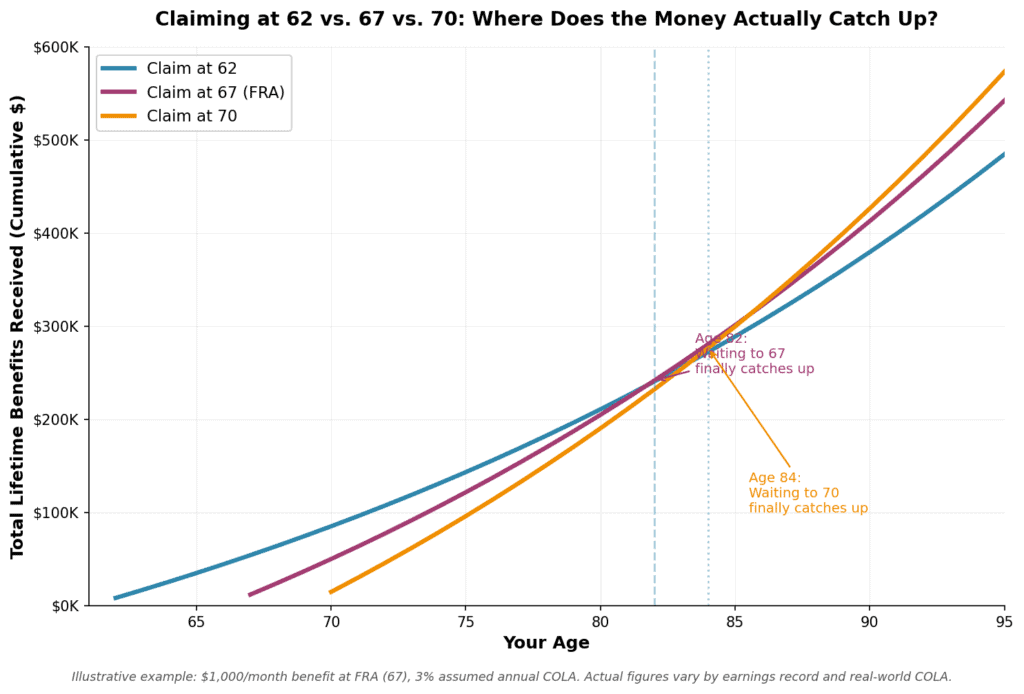
The chart above makes the same point in dollars instead of percentages. It assumes a $1,000/month benefit at full retirement age (67), with a 3% assumed annual COLA, and tracks cumulative lifetime benefits at each claiming age. Notice how long it takes for waiting to actually pay off: claiming at 62 stays ahead in total dollars received until around age 82 compared to waiting until FRA, and until around age 84 compared to waiting all the way to 70. For a big chunk of retirement, the “smaller” early check has already put more real money in your pocket.
A real-world example: the 2023 COLA spike
Think back to inflation just after COVID. The 2023 COLA hit 8.7% — actually higher than the flat 8%/year delayed retirement credit itself. That’s a vivid reminder: COLA and the delayed retirement credit are two separate things. In an unusual year, COLA can outpace the “reward” people assume they’re locking in by waiting.
A quick note on the more rigorous math
Researchers also calculate this a second, more technical way. They treat the three years of skipped checks as an upfront cost. They treat the larger future benefit as a lifetime income stream. Then they solve for the internal rate of return (IRR).
A recent analysis from researcher Michael Kitces frames it this way: delaying means funding those years from your own portfolio instead of collecting benefits. So the real “cost” of waiting is whatever return that portfolio would have earned otherwise — typically 4% to 5% real for a balanced 60/40 mix. (Why Delaying Social Security Benefits Isn’t Always The Best — Kitces.com) That same piece cites a 2024 Journal of Financial Planning study. At a 4% real return assumption, you’d need to live to 89 for delaying from 67 to 70 to pay off. Most men — 77% — don’t reach 89. Neither do 65% of women.
Both approaches land in a similar honest range: roughly 4% to 5% real. Not the flat 8% you’ll see quoted everywhere.
So does that mean you should take it early?
Not automatically. But “always wait until 70” isn’t the slam-dunk it’s often presented as. The math gets more nuanced when inflation runs elevated.
Reasons to consider claiming early
- You can invest the money for more than the real return of waiting. Say a reasonably conservative, diversified portfolio can realistically earn more than roughly 4%–5% real over your remaining years. In that case, taking benefits early and investing them can outperform waiting — on paper, before you factor in market risk, which waiting doesn’t carry.
- Health or family longevity is a real concern. The delayed credit only pays off if you live long enough to collect the higher check for enough years. If that’s not a safe bet for you, earlier claiming often wins on a lifetime-dollars basis.
- You want income now, not later. Even a mathematically “worse” choice can be the right one. It might let you retire on your own timeline, avoid drawing down savings, or reduce financial stress today.
Reasons to still consider waiting
- Longevity protection. Social Security offers guaranteed, inflation-adjusted lifetime income, and waiting increases it. If you or your spouse could live well into your late 80s or 90s, that insurance carries real value a pure rate-of-return calculation doesn’t fully capture.
- Survivor benefits. If you’re the higher earner in a couple, delaying can permanently raise your spouse’s benefit after you’re gone. That’s often the single biggest reason planners recommend delaying for one spouse, even when the raw numbers look close.
- You’d rather not rely on market performance. The federal government essentially guarantees the 4%–5% real return from delaying. Beating it in the market is likely over time, historically, but it’s not certain. Social Security often serves as the “safe” bucket in a retirement plan for exactly that reason.
One big caveat: Are you still working?
If you’re still earning a paycheck and you claim before full retirement age, a separate rule can blunt the appeal of claiming early: the earnings test.
For 2026, the limit is $24,480 for anyone under FRA all year — up from $23,400 in 2025. Earn more than that while collecting benefits, and Social Security withholds $1 for every $2 you earn above it. In the year you reach FRA, the limit jumps to $65,160, with a gentler $1-for-$3 withholding. Once you hit FRA, the limit disappears entirely.
Two things soften this rule, though. First, it only counts earned income — wages or self-employment pay. Pensions, investment income, and savings withdrawals don’t count against it. Second, withheld benefits aren’t gone for good. Social Security recalculates your benefit once you reach FRA and credits back the months it withheld, which permanently raises your future monthly check.
Still, if you plan to keep working substantially past 62, the earnings test is worth running through your own numbers before you claim early. It won’t cost you in the long run, but it can mean smaller checks — or no check at all in some months — while you’re still earning above the limit.
The bottom line
Social Security’s current cash deficit isn’t breaking news to actuaries. The Trustees Reports have shown it for years. What’s changed is that mainstream financial commentators, like Arends, are now saying it plainly — instead of burying it in trust-fund talk that makes the program sound safer than the cash-flow numbers suggest.
The “wait until 70 for a guaranteed 8%” advice deserves the same scrutiny. The 8% is real, but it’s nominal. With inflation and COLA running in the high-3s to 4% range heading into 2027, the real advantage of waiting sits closer to 4%–5% a year — not 8%. That’s still valuable, especially as longevity insurance. But weigh it against what you could realistically earn by claiming earlier and investing the difference.
This isn’t a one-size-fits-all answer, and it isn’t financial advice tailored to your situation. Talk with a fee-only financial planner, or use SSA’s own claiming tools, before you decide. If you’ve been putting off the decision because “everyone says wait,” run your own numbers with the real, inflation-adjusted math — not just the headline number. And don’t forget the time value of money — a dollar in your pocket today is worth more than the same dollar promised to you years from now. Cash is King.
FAQ
Does Social Security really run out of money in 2032? No. That date refers to projected depletion of the trust fund’s reserves, not the end of the program. The 2026 Trustees Report, released in June 2026, moved the projected depletion date up to 2032 — a year earlier than the prior report. Even with reserves fully depleted and no changes to the law, incoming payroll taxes would still cover the large majority of scheduled benefits — current projections point to roughly a 22% across-the-board cut, not a full stop in payments. Congress has adjusted the program before, and it could again.
Is the 8% delayed retirement credit still worth it? It depends on your health, family longevity, marital status, and what you’d otherwise do with the money. In real, inflation-adjusted terms, delaying from full retirement age to 70 works out closer to a 4%–5% annual return — not the flat 8% headline. It’s valuable, but not the guaranteed windfall some claim.
What’s the difference between the early-claiming reduction and the delayed retirement credit? Claim before full retirement age — as early as 62 — and the early-claiming reduction permanently lowers your benefit. Wait past full retirement age, up to 70, and the delayed retirement credit permanently raises it by about 8% per year. They’re separate mechanisms on either side of full retirement age.
Does COLA apply even if I haven’t claimed benefits yet? Yes. Your benefit gets adjusted for inflation each year starting well before you claim, based on your earnings record. Waiting doesn’t cost you any COLA increases.
At a glance: benefit growth by claiming age (FRA = 67)
| Claiming Age | % of Full Benefit | Mechanism |
|---|---|---|
| 62 | 70% | Early-claiming reduction (permanent) |
| 63 | 75% | Early-claiming reduction |
| 64 | 80% | Early-claiming reduction |
| 65 | ~86.7% | Early-claiming reduction |
| 66 | ~93.3% | Early-claiming reduction |
| 67 (FRA) | 100% | Baseline |
| 68 | 108% | Delayed retirement credit (nominal) |
| 69 | 116% | Delayed retirement credit (nominal) |
| 70 | 124% | Delayed retirement credit (nominal); credits stop here |
Figures are illustrative percentages of your full retirement age benefit. They don’t include COLA, which applies on top of these amounts every year regardless of claiming age.
Disclaimer: This article is for general educational and informational purposes only. It doesn’t constitute financial, tax, legal, or investment advice. Your Social Security claiming decision depends on your individual health, marital status, work history, other retirement income, and financial goals — the right choice for one person may not fit another. Benefit figures, COLA estimates, and actuarial projections here reflect publicly available data as of mid-2026 and may change once official figures come out. Before you decide, consult a qualified, fee-only financial planner, or use the Social Security Administration’s own tools at ssa.gov, or speak directly with the SSA to get figures based on your specific earnings record.