
With April being Financial Literacy month, you may be interested in this information. Most of you have heard of the “Magnificent 7” stocks of the S&P 500……..can you name them?
More importantly, are you aware of the (huge) influence these seven stocks have over both the S&P 500 (especially given all the recent “tariff talk volatility)? And potentially your retirement portfolio?
Let me shed some light on this, with help from ChatGPT and Yardeni Research.
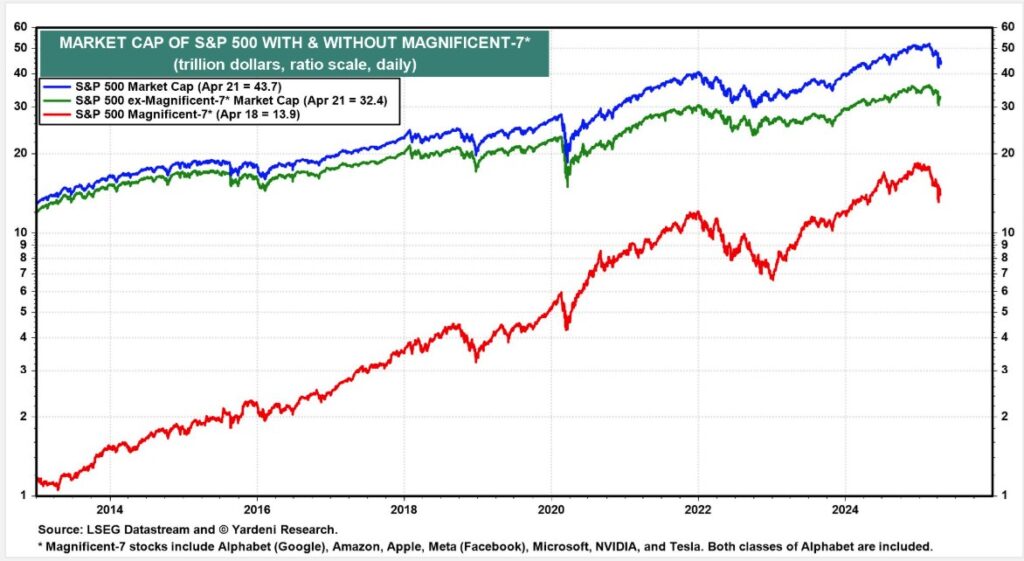
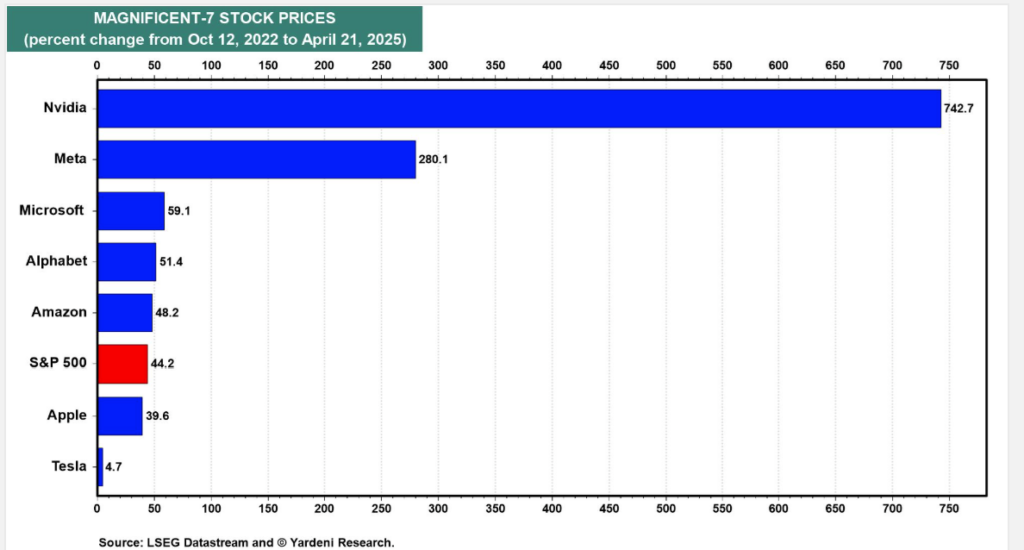
The Mag 7 stocks—Apple, Microsoft, Alphabet (Google), Amazon, Meta Platforms, Nvidia, and Tesla—had a combined market cap of $14.0 trillion as of April 16, 2025. This represents a significant decline of $3.6 trillion (–20.4%) year-to-date, largely due to escalating trade tensions and tariff uncertainties. Notably, Tesla’s market cap dropped by 40.1%, and Apple’s by 22.9% during this period.
This means Mag 7 currently make up approx. 32% of the S&P 500’s total $43.378 trillion market cap.
While exact numbers are not publicly available, it’s common for large-cap equity mutual funds and index funds to hold all of the Mag 7 stocks, given their significant weight in the S&P 500. Additionally, major asset managers like BlackRock have substantial positions in all seven stocks across various mutual funds and ETFs.
These graphs provide further context (all graphs come from Yardeni Research)

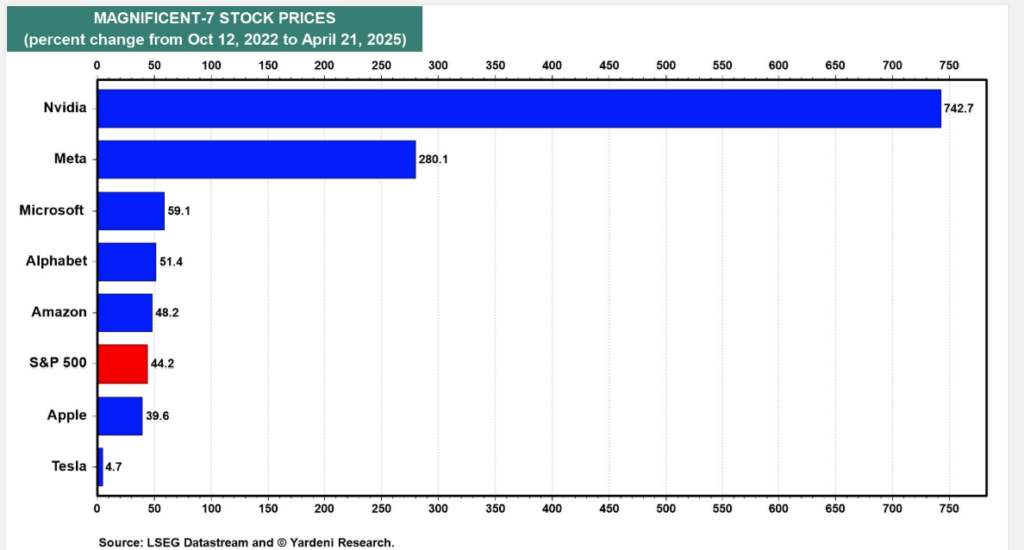

What Can You Take Away from This?
First, while this level of concentration in the equity markets is not new, you need to be sure you are properly diversified. Owning too many mutual funds or ETF’s with these “magnificent 7” stocks (aka high correlation) is very risky.
Remember, portfolio managers often have high correlations during market rises to boost/maintain returns and increase their performance-based bonuses. If you are in or close to retirement, do you really need to hit home runs with the risk of losing a lot of money and a lot less time to make it up? (see previous blog).
Make sure you know what you own and why you own it.
Disclaimer: The information in this blog post is for educational and informational purposes only and should NOT be construed as financial or investment advice. Investing carries risks, including the loss of principal. Always conduct your own research and consider consulting with a qualified financial professional before making any investment decisions.