

A note before we dive in: I’ll be honest — I didn’t fully understand preferred securities/stocks until I started researching my own retirement income options earlier this year, as I approached 65. What I found surprised me. These investments sit in a kind of no-man’s land between stocks and bonds, which means most people overlook them entirely. That’s a shame, because for retirees who need reliable income, they can be genuinely valuable. Let me explain what they are and how they work.
Where Do Preferred Securities Fit?
Preferred securities sit in the Core Income section of the Retirement Income Pyramid — right alongside investment-grade bonds and dividend-paying stocks.
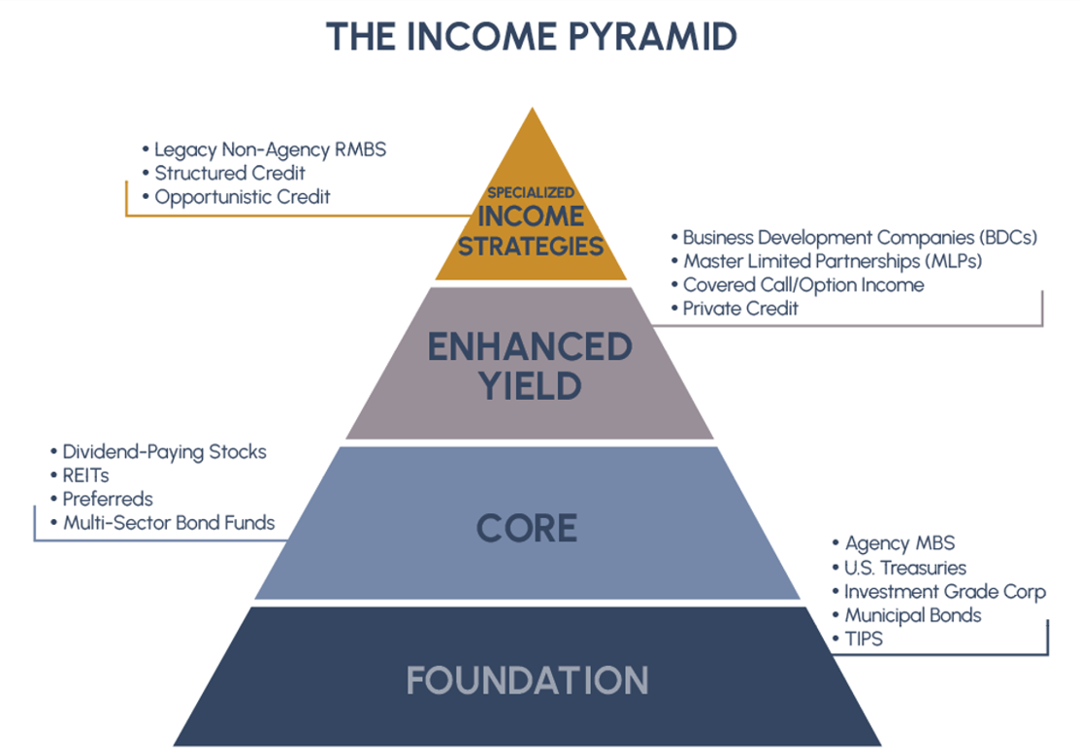
They typically pay more income than common stocks and carry stronger credit quality than most high-yield investments. Think of them as the middle ground your portfolio might be missing.
What Exactly Is a Preferred Security?
The name sounds complicated, but the idea is simple.
When large companies — banks, insurance companies, utilities — need to raise money, they sometimes issue preferred shares. Buying one of these is a bit like lending a company money, except instead of interest, you receive dividends.
Here’s what makes them “preferred”: if the company ever runs into trouble, preferred shareholders get paid before common stockholders. And if dividends get cut, common shareholders lose theirs first. You’re not at the front of the line — bondholders still come before you — but you’re in a much better spot than someone who owns the company’s regular stock.
The trade-off? Preferred shares don’t grow the way common stocks do. You’re not buying them hoping the price doubles. You’re buying them because they can provide a dependable paycheck, quarter after quarter. Sometimes even monthly.
Why Do Retirees Use Them?
Here’s the challenge many retirees face: investment-grade bonds are safe, but sometimes they just don’t pay enough yield or interest income. And dividend stocks are great, but their income can take time to build up.
Preferred securities can help fill that gap. They typically offer:
- Higher income than investment-grade bonds (as of this post – 5-8% range)
- Higher income than most dividend-paying stocks
- Regular payments from some of the largest, most established financial companies in the country
- A source of diversification that isn’t purely stocks or purely bonds
For retirees who depend on their portfolio to generate a paycheck — rather than selling off investments — that combination is hard to ignore.
How Much Income Are We Talking About?
Historically, preferred securities have yielded somewhere in the range of 5% to 8%, though that varies with interest rates and market conditions.
Many preferred issues pay on a fixed schedule — quarterly or monthly — and come from companies with decades of uninterrupted payment histories.
One important thing to keep in mind: while the payments themselves have historically held up well, the price of preferred shares can bounce around, especially when interest rates shift. If you’re investing for the income stream rather than planning to sell, those day-to-day price moves matter a lot less. But it’s still good to know going in.
A Quick Word on Taxes
This is a detail that catches a lot of people off guard: not all preferred dividends are taxed the same way. Some qualify for the lower long-term capital gains rate, the way many common stock dividends do. Others are taxed as ordinary income, similar to bond interest — this is more common with preferreds issued by REITs and some financial companies. Which bucket a given preferred falls into depends on how it’s structured and who issued it.
This isn’t something to guess at. If you’re adding preferreds to a retirement income plan, it’s worth asking your tax preparer how a specific holding (or fund) will actually be taxed before you count on a certain after-tax number.
What to Know Before You Invest
No investment is perfect, and preferreds have some real risks and quirks worth understanding.
Rising interest rates. When rates go up, preferred prices often go down — sometimes more sharply than regular bonds, because many preferreds have very long maturities or no maturity date at all. This is important if you need to sell – you can take a loss of this investment.
Being “called away.” Most preferred shares allow the company to buy them back at a set price — usually after five years. If rates fall, companies often do exactly that, refinancing into cheaper options and handing you back your money right when you’d rather keep collecting those higher payments.
Heavy concentration in financial companies. Most preferreds are issued by banks and insurance companies. That’s not necessarily a red flag — these tend to be very large, well-capitalized institutions — but it does mean you want diversification across many issuers rather than betting on just a handful of names.
Price swings during crises. The 2008 financial crisis and the COVID panic in 2020 both caused preferred prices to drop sharply — even when many companies kept paying their dividends. If you’re watching your account balance closely, that can be nerve-wracking. Keeping your eye on the income rather than the price is key.
Cumulative vs. non-cumulative. With cumulative preferreds, any missed dividend payments have to be made up before common shareholders get anything. With non-cumulative ones, missed payments are gone for good. It’s an important distinction if you’re considering individual issues rather than a fund.
How Should You Own Them?
For most retirees, a professionally managed fund or ETF is the simplest and safest path.
Here’s why: there are thousands of individual preferred securities out there, each with different structures, call dates, tax treatment, and interest-rate features. Sorting through all of that is genuinely complex — more so than picking individual stocks. A good fund does that work for you while spreading the risk across hundreds of issuers.
If you’re evaluating a preferred securities fund, a few things worth checking – or asking your financial advisor:
- Expense ratio — costs eat directly into the income you’re trying to capture
- Credit quality of the underlying holdings — is it concentrated in investment-grade issuers, or reaching into riskier territory for yield?
- Duration/rate sensitivity — how much the fund’s price tends to move when rates shift
- Issuer diversification — how many different companies it holds, not just how many securities
Some experienced investors do buy individual preferreds directly, and that can work well — but it requires meaningful research and ongoing attention.
How Much Should You Own?
Preferreds work best as a complement to your other income sources, not the foundation of your whole portfolio. In general, they tend to play a smaller supporting role than your core bond holdings — sized to how much extra income you need and how much price movement you’re comfortable with.
This is very much a “your mileage may vary” question, and it’s one worth working through with a financial advisor who can look at your full picture — your other holdings, your income needs, and your tolerance for price swings — rather than a one-size-fits-all number.
They pair well with high-quality bonds and dividend-paying stocks — each one doing something the others can’t quite do on their own.
How Do Preferreds Compare to What You Already Own?
This is where a lot of retirees get confused, so here’s a simple side-by-side:
| Investment-Grade Bonds | Preferred Securities | Dividend Stocks | |
|---|---|---|---|
| Main purpose | Stability and predictable income | Higher income | Growing income over time |
| Typical yield | Lower | Moderate to high | Moderate |
| Income reliability | Highest | High | Moderate |
| Room to grow? | None | Very little | Yes |
| Price swings | Low to moderate | Moderate | Moderate to high |
| If the company fails | First in line | Ahead of common shareholders | Last in line |
| Best role in your portfolio | Foundation | Income boost | Inflation protection |
Think of these three as teammates. Bonds provide stability. Preferred securities boost your income. Dividend stocks help your purchasing power keep up with inflation. A well-built retirement portfolio often includes all three.
The Bottom Line
Preferred securities won’t make headlines and they won’t double in value. That’s not what they’re for.
What they can do is add a meaningful income boost from financially strong companies — more than most bonds pay, with less of the business risk that comes with common stocks.
For retirees who are building a portfolio designed to produce cash flow for decades, preferred securities can be a genuinely useful piece of the puzzle. Not the whole picture — but a piece most people overlook, often to their detriment.
This article is for educational purposes and isn’t personalized investment or tax advice. Talk with a financial advisor or tax professional before making changes to your portfolio.
If you are looking for more information check out Schwab’s information here: What Is Preferred Stock? Basics, Benefits, and Risks | Charles Schwab