
Financial folks love to talk about things like beta, standard deviation, sharpe ratio, and a lot of other terms most of their clients (you) don’t really understand or care about.
What you do care about is losing money. And given what’s going on in the stock markets lately, what is it going to take just to get you back to break even?
As a sign at our favorite Italian restaurant says;
“la matematica non e’ una opinione”
Translation, math has no opinion, and given April is Financial Literacy Month, let’s dive into the stock market math.
The Math
This formula expressed as a change from the initial value to the final value or percentage change. We learned it in high school.
Percentage Change = (Final Value – Initial Value)/ Initial Value * 100%
For example, if you lose 30%, you need to recover 43% just to get back to breakeven.
The impact of percentage changes on the value of a $1,000 investment shown in the Table below.
Impact of Percentage Changes on an Investment of $1,000
The impact of percentage changes on the value of a $1,000 investment shown in the Table below.
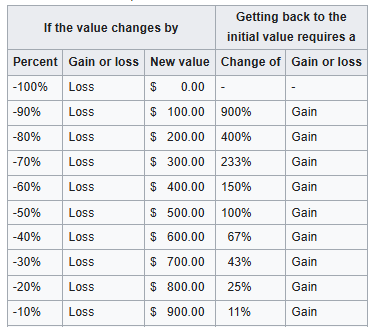
In other words, from the bottom of the chart and going up, if you had a 10% loss, you would need an 11% increase to breakeven. A loss of 20% requires a 25% market recovery to breakeven (a bear market). A 30% loss requires a 43% recovery to breakeven and so on. Or shown in another way on a graph below.

Of course, none of this accounts for the TIME it takes to recover. Sometimes it’s fairly fast, like 2020 and the COVID-19 crisis. In others like the Great Depression, stocks didn’t fully recover for 16 years. See Understanding Stock Market Cycles by Schwab HERE.
What can you do?
First talk with a financial professional about your goals and objectives over the next few years, especially if you are nearing retirement. Make sure you have funds available in several buckets, so you don’t have to tap into fund that need to recover losses.
- Short term cash – for necessities and daily living. Try to have 6 months or a year of funds available.
- Longer term investments providing cash flow. Principally protected investments such as dividend paying funds, bonds, REITs etc. (please work with your financial advisor on the best investments for your risk tolerance)
- Growth investments – again work with your advisor – but these will be investments that you can leave along to recover if the market needs time to recover.
I hope you liked this post. Please subscribe below for weekly updates for this blog.
Disclaimer: The information in this blog post is for educational and informational purposes only and should NOT be construed as financial or investment advice. Investing carries risks, including the loss of principal. Always conduct your own research and consider consulting with a qualified financial professional before making any investment decisions.